
Listen to Australian and world news and follow trending topics with SBS News Podcasts.
TRANSCRIPT:
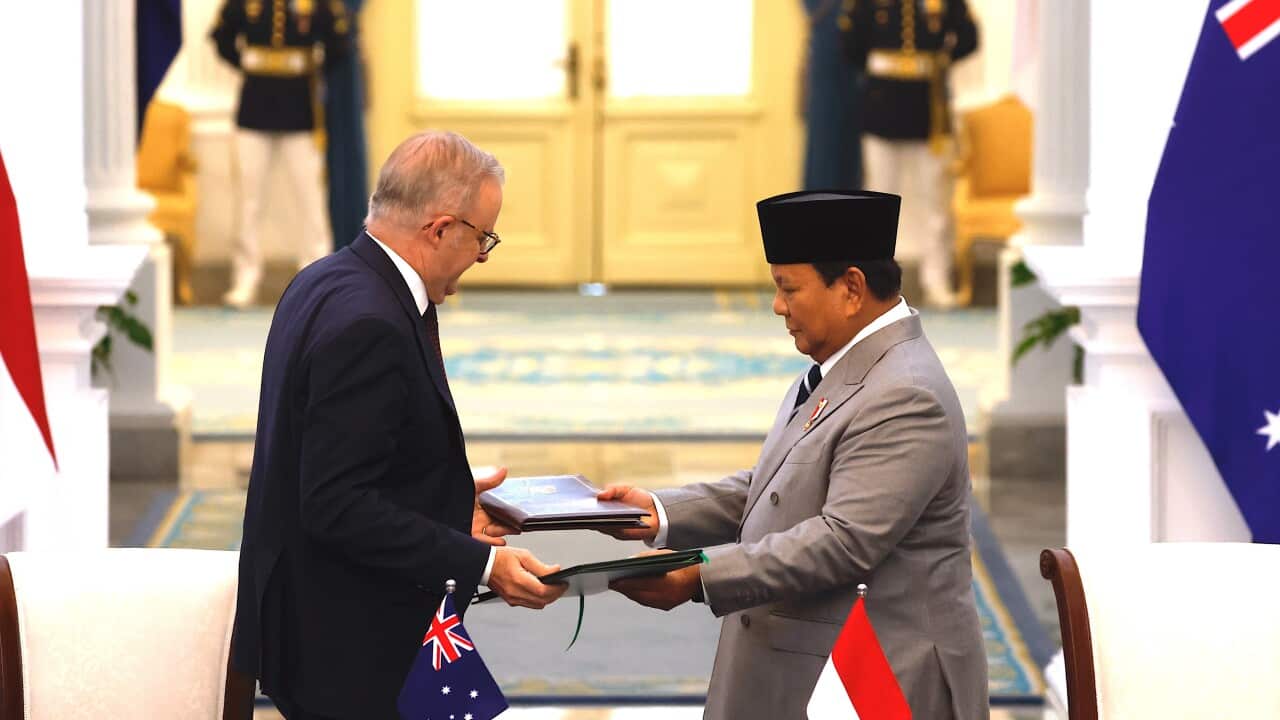
"And today, Prime Minister Albanese and I reaffirmed Indonesia's close relation with Australia to continue to strengthen Indonesia - Indonesia and Australia's partnership through the signing of the Treaty of Common Security. This treaty reflects the commitment of both countries to continue strengthening its cooperation."
President Prabowo Subianto speaking through an interpreter - as he joined Prime Minister Anthony Albanese in Jakarta to sign a landmark treaty between Indonesia and Australia.
Announced in November, the Australia-Indonesia Treaty on Common Security represents a pivot in Jakarta’s foreign policy, signalling a move away from its traditional stance of non-alignment toward a more integrated defence partnership.
Mr Albanese is describing the signing of the treaty as a watershed moment.
"This signals that Australia’s and Indonesia’s relationship is stronger than it’s ever been. The fact we are signing this treaty today is testament to president Prabowo’s strong leadership and his personal commitment to promoting security in our region, and indeed around the world."
During the press conference in Jakarta, Mr Albanese detailed a roadmap for deepening military ties.
He outlined the establishment of a new embedded position for a senior Indonesian officer in the Australian Defence Force, reflecting and reinforcing what he says is the trust between the two nations.
Mr Albanese also outlined other measures.
"Supporting the development of joint defence training facilities to increase Indonesia's ability to conduct joint exercises with including in Australia, and expanding military education exchanges when our militaries to build relationships and increase understanding between our next generation of military leaders."
However, Susannah Patton from the Lowy Institute says that the Australian government’s rhetoric is overstated.
Ms Patton says that while few would have predicted such an agreement given Indonesia’s non-aligned history, the tides have shifted under President Subianto who is more willing to break with foreign policy tradition.
She says the text will be modelled on the 1995 Australia-Indonesia agreement to avoid a binding mutual defence obligation like the one currently held with Papua New Guinea.
This structure ensures the pact remains a consultation process rather than a strict military requirement.
"There is still a very big difference between the way that Australia and Indonesia see the world, and this agreement doesn't fundamentally change that. And I think it's hard to argue that either country will really change the trajectory of its own foreign policy as a result of this treaty. So it's a welcome development, but perhaps not as significant as the term 'watershed' which the Prime Minister is using would imply."
Damien Kingsbury, an emeritus professor at Deakin University in Victoria says the treaty represents a strategic re-positioning of two "middle powers" in an increasingly turbulent world.
Mr Kingsbury has spent years highlighting human rights issues in West Papua, a region defined by a decades-long struggle for independence.
He suggests that the treaty will sideline the ongoing issues in West Papua.
"Australia's defence treaty with Indonesia is largely symbolic. It doesn't have, at least not publicly. It doesn't have any written in commitments by either country, but it is part of Australia's re positioning with other middle powers in what is an increasingly uncertain global environment in terms of human rights issues, particularly in relation to West Papua. It does mean that West Papua, yet again, gets swept under the carpet, but given that Australia has long committed to Indonesia's territorial integrity, I don't realistically think we could have expected anything else to come out of it."
He says that if the Australian government were to speak out on West Papua, it would likely cost them the defence treaty.
"So has West Papua been sacrificed on the altar of greater regional stability? Probably, yes. Again, that this is, basically, business as usual it has been thus, since time immemorial. Australia, and ultimately, never said at any point that it would support an independent West Papua."
Melbourne University's Tim Lindsey, a leading expert on Indonesian law told SBS that the increasing visits to Indonesia are positive.
But he also suggests that President Subianto’s leadership style is reminiscent of the leadership style of the Suharto era.
“The current crackdown on democracy activists and civil society in Indonesia by the government of Robert Subianto is much more concerning for Australia, if not in the immediate and certainly in the longer term, after riots in August last year, responding to misconduct of politicians and police brutality, riots emerged. A crackdown followed, in which thousands were arrested, some disappearances took place. Torture has been alleged, and now hundreds democracy activists face trial. President Prabowo has blamed these riots both on activists but also on covert foreign interference. He's described the activists as foreign lackeys, and spoken of shadowy foreign forces who he claims are manipulating these activists who he describes as traitors and terrorists."
Professor Lindsey says that President Subianto's government is now announcing a new bill to counter so-called foreign propaganda and disinformation.
He says while final details of the bill are yet to be finalised, one of the proposals is that it would extend its reach to Indonesians living overseas.
“So it is not difficult to imagine a future where a critic of the increasingly authoritarian regime of Prabowo Subianto in Jakarta might fall foul of that government, and their return to Indonesia might be demanded. That would put us, Australia, in a very difficult situation. Now, none of this has come to pass, but it would certainly drain relations between the two countries significantly.”
A memorandum of understanding was also signed between Australia and Indonesia's sovereign wealth funds to boost two-way investment.
The visit by Mr Albanese to Indonesia is his fifth since becoming prime minister in 2022.